BY CECILIA OGEZI
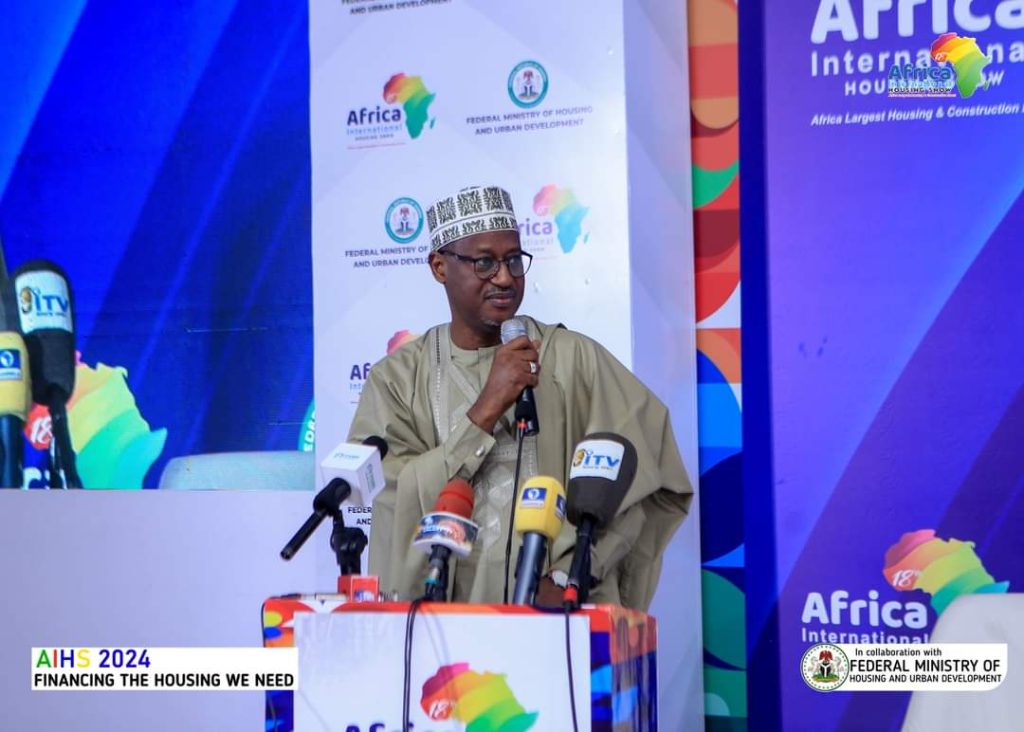
In his address at the on-going African International Housing Show (AIHS), the Minister for Housing and Urban Development and Chief host of the program, Arc. Ahmed Dangiwa, underscored the critical need for comprehensive reforms in Nigeria’s housing sector. He highlighted that approximately 75 percent of Nigeria’s 42 million housing units are substandard, necessitating a renewed approach to address these pervasive challenges.
Dangiwa emphasized that housing cannot be handled in isolation, as it is intrinsically linked to various sectors within the value chain. Since assuming office in 2023, the ministry has adopted a value chain approach to mitigate the housing deficit, implementing yearly interventions and encouraging local manufacturing of building materials. Partnerships are open to capable institutions willing to contribute to this cause.
The population of Nigeria, standing at approximately 220 million with an annual growth rate of 2.5 percent, demands 550,000 housing units yearly to keep pace. This ambitious goal requires an annual investment of around 300 billion Naira, totaling 95.2 trillion Naira over the coming years.
Chairman of the ceremony, Pastor Matthew Ashimolowo, reiterated that the theme of the conference, “Financing the Housing That We Need,” is both apt and timely. As finance is crucial to housing and real estate development, serving as a fundamental factor of production. At both ends of the value chain, finance is essential to meet the demand and supply of housing.
He said on the supply side, developers require construction or ‘wholesale’ finance to execute housing projects. On the demand side, mortgage or ‘retail’ finance is a critical driver for purchasing or renting decisions.
Adding that the high cost of funding in our environment, developers must be intentional, innovative, and pragmatic about their financing strategies.
He further noted that one effective strategy for his organization has been “Land Banking.” Which has helped to create, consolidate, accumulate, and unlock finance for future projects.
In his address, the Senate President, Godswill Akpabio, stressed the importance of consolidating President Tinubu’s renewed hope housing agenda, which envisions everyone having access to shelter. Represented by Senator Victor Umeh, Akpabio noted that the AIHS serves as a platform to showcase best practices and leverage expertise. He emphasized that housing is a cornerstone of a prosperous society and through inclusive policies, a robust ecosystem can be created. The Senate, in collaboration with the Ministry of Housing, is committed to addressing the challenges obstructing decent housing holistically.
The Speaker of the House of Representatives, Abass Tajuddeen, highlighted the need for coordination and streamlining policies to monitor housing projects effectively. Represented by Abdulmumin Jibril, Chairman of the Housing Committee/Habitat, Tajuddeen pointed out that urbanization leads to increased population in urban centers, necessitating innovative solutions to navigate these challenges. Incentives can stimulate housing projects, expanding access to mortgages, and implementing social housing initiatives for low-income earners to ensure decent housing for all.
The sector director for Infrastructure at the UK Department for Business and Trade Africa, Radwa Sultan, commended AIHS for establishing itself as Africa’s largest housing forum. She acknowledged the critical nature of housing alongside food and water and emphasized that the forum would forge partnerships for economic growth.
Nathaniel Atebije, President of the National Institute of Town Planners, called for an end to paying lip service to housing issues. He urged that resolutions should be backed by holistic implementation and stressed that housing thrives in well-planned environments, urging the engagement of professional planners to actualize the dream of adequate housing.
Shehu Osidi, Managing Director of the Federal Mortgage Bank, praised the efforts of AIHS organizers, describing the event as a vital platform for exchanging ideas in the housing industry. He highlighted the importance of enhancing financing capabilities and expanding access to housing loans for medium and low-income earners, noting that much work remains to be done, underscoring the necessity of such forums.