By Capital Watch Media
Prominent Nigerian leaders, including former President Olusegun Obasanjo, have raised concerns about the state of democracy in the country, warning that it is under threat.
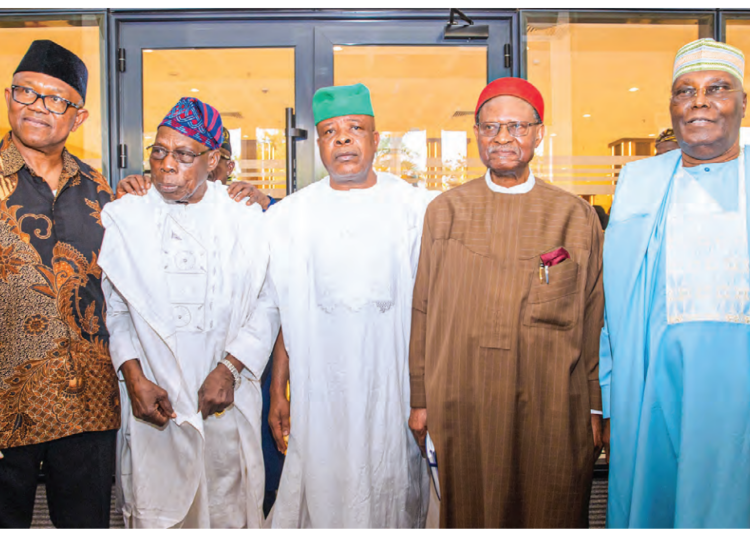
Speaking at a colloquium in Abuja to mark the 60th birthday of former Imo State Governor Emeka Ihedioha, leaders from different political backgrounds expressed fears that democracy in Nigeria was not serving the people effectively.
Catholic Bishop of Sokoto Diocese, Matthew Kukah, in his keynote address titled “Is Democracy Failing in Africa?”, noted that Nigeria’s democratic system appeared to favour only a select few.
“We as Africans inherited a system that is not ours, but we cannot say it is not relevant. There is an urgent need to clean up the mess,” Kukah stated.
The cleric also expressed concerns over the increasing pressure on the judiciary, adding that judges were being influenced in political matters.
Peter Obi, a former Labour Party presidential candidate, disagreed with Kukah’s assertion that democracy in Nigeria was a work in progress.
“They started in 1999 and laid the foundation. Some people came and built on it. But now, everything has been knocked down,” Obi lamented.
He recalled how he became governor of Anambra State through the courts, without paying bribes, a situation he said was rare in present-day Nigeria.
Former President Olusegun Obasanjo described what is being practised in Africa as “representative democracy”, which he said does not reflect the true will of the people.
“Abraham Lincoln described democracy as government of the people, by the people, and for the people. But what do we have today?” Obasanjo questioned.
He added, “Democracy in Africa has failed because it is not rooted in our culture and way of life. People are told to ‘go to court’ when they know they cannot get justice.”
Former Vice President Atiku Abubakar recalled the sacrifices made for democracy, stating that he had to go into exile due to political persecution during the military regime.
“In my case, I ran into exile because Abacha was very hostile,” Atiku said, reflecting on the struggle for Nigeria’s democratic transition.
Former Sokoto State Governor, Aminu Tambuwal, criticised the National Assembly’s handling of the recent state of emergency imposed on Rivers State.
“Under Obasanjo, the National Assembly followed due process in approving a state of emergency. But what happened recently? We need to chase out bad actors in democracy,” Tambuwal stated.
Chief Emeka Anyaoku, former Secretary-General of the Commonwealth, called for an urgent review of the 1999 Constitution to address structural issues affecting governance.
“We need a new constitution to tackle our challenges. True federalism is the answer to our national problems,” Anyaoku asserted.
He warned that recent political instability in Mali and Niger should serve as a lesson for Nigeria.
The Speaker of the House of Representatives, Tajudeen Abbas, took a different stance, arguing that Nigeria was making progress despite its challenges.
“For me, democracy has come to stay in Nigeria. It is a process that is being consolidated despite difficulties,” Abbas said.
He noted that elections remained the foundation of democracy and that Nigeria had successfully conducted several transitions of power.
The event concluded with a call for urgent reforms to strengthen democratic institutions and ensure governance benefits all Nigerians.